Parries
A parry is a choreographed defensive response to an attack line.
In casual teaching, people may say "block."
In Saber Standard Notation, a parry is written as the target number plus the letter P.
Plain-English version
If an attack is written as 1, the matching parry is written as 1P.
Basic parry notation
A number followed by P is a parry. The number tells the reader which target line is being received or answered, and the P tells them the action is a parry rather than an attack: 1P answers an attack to target 1, 11P answers target 11, and so on.
The beginner set is 1P, 11P, 3P, 9P, 5P, and 7P — the same six lines as the attacks, with P appended. For what each of those lines means, see Targets. The full twelve-line reference is in the Notation Legend.
Parries in a two-Saberist table
In a Saber Standard table, the parry appears in the step column for the Saberist performing the defensive response.
| Player | Step 1 | Step 2 | Step 3 |
|---|---|---|---|
| Saberist A | 1 | 11 | 3 |
| Saberist B | 1P | 11P | 3P |
Read this vertically:
- Step 1: Saberist A attacks
1; Saberist B parries1P. - Step 2: Saberist A attacks
11; Saberist B parries11P. - Step 3: Saberist A attacks
3; Saberist B parries3P.
Common beginner mistakes
| Mistake | Correction |
|---|---|
| Waiting too long to move | Start the parry as part of the shared timing |
| Swatting at the attack | Meet the line with control |
| Overpowering the partner | Reduce force and preserve choreography |
| Parrying the wrong line | Slow down and match the written target |
| Treating the parry like a real fight response | Keep it theatrical, repeatable, and safe |
Parry diagrams
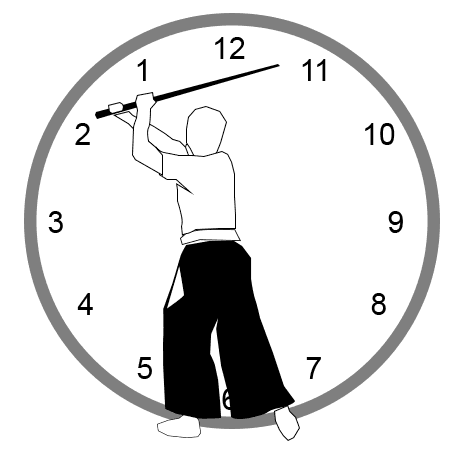 Parry 1 |
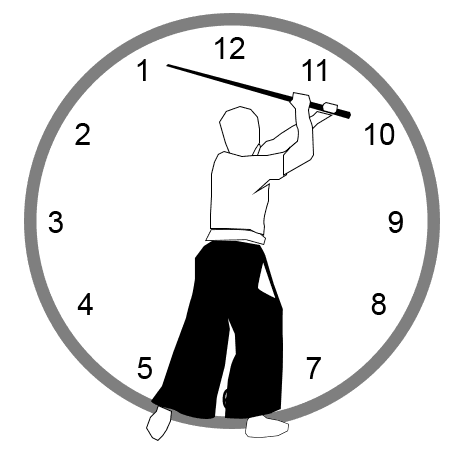 Parry 11 |
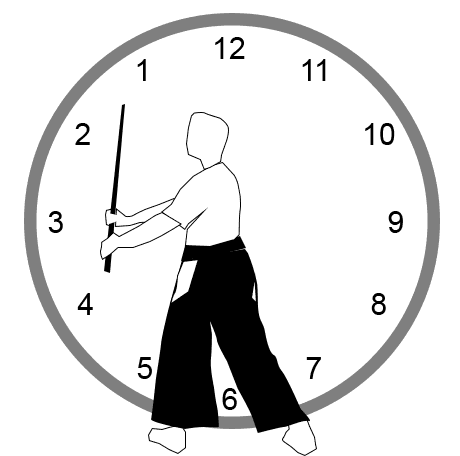 Parry 3 |
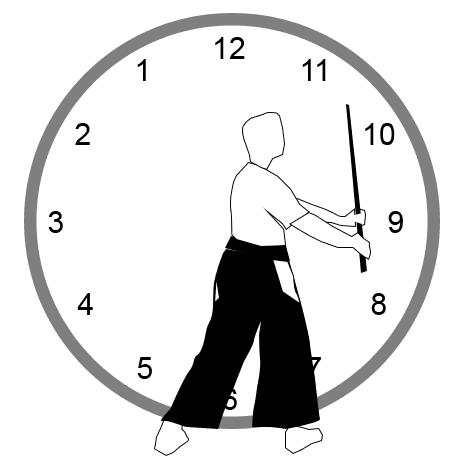 Parry 9 |
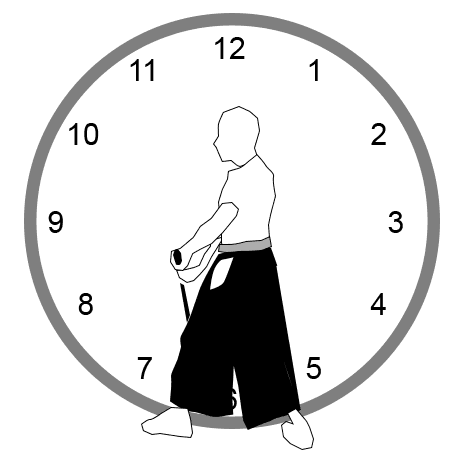 Parry 5 |
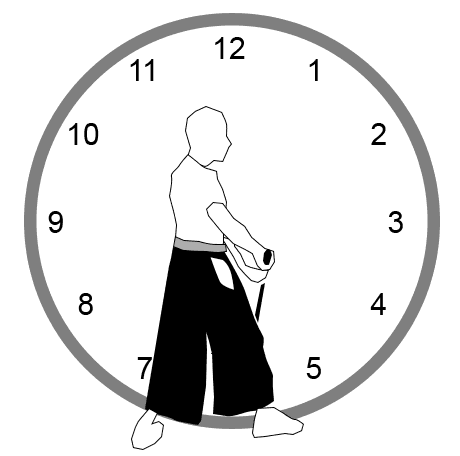 Parry 7 |