Start Here
Welcome to the Saber Standard.
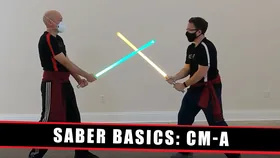
This page is the shortest safe path into the system. You do not need to understand the entire standard before you begin. You only need a partner, a safe training space, and enough notation to practice the first core movement: CM-A.
What the Saber Standard is
The Saber Standard is a lightsaber choreography standard. It is used to record, teach, share, and safely perform choreographed saber combat.
What the Saber Standard is not
The Saber Standard is not full-contact sparring, dueling, fencing, or combat training for real weapons. It is controlled partner choreography.
1. Start with CM-A
CM-A is the first core movement, and every step of it is written in Saber Standard Notation. Before you practice it, get familiar with how that notation reads.
Select the diagram above, or go straight to the Notation Overview.
Practising away from a screen? Print the Quick Start Guide — one page with the target diagrams and every core sequence on it.
2. Safety baseline
Before anything else, agree on safety.
A Saber Standard exchange should be practiced with control. The goal is not to hit your partner. The goal is to create a clean, readable, repeatable movement pattern together.
Minimum practice rules:
- Use appropriate training sabers or safe props.
- Check your distance with your partner before starting any sequence.
- Make eye contact with your partner as the signal that you're both ready to begin.
- Move slowly when learning.
- Stop before contact.
- Do not strike the body.
- Do not surprise your partner.
- Reset when either partner feels unsafe or confused.
- Increase speed only after both partners understand the pattern.
If the movement is not safe, it is not correct.
3. Why use notation instead of video alone?
Video is powerful. But video alone is fragile.
Most choreography communities rely almost entirely on:
- memory
- demonstration
- verbal explanation
- recordings
- instructor interpretation
That works well for short-term teaching.
But over time, choreography becomes difficult to preserve consistently.
Sequences change.
Details are forgotten.
Different instructors remember different versions.
Videos disappear.
Footwork becomes unclear.
Timing drifts.
And eventually, choreography that once existed clearly becomes fragmented or lost.
The Saber Standard was created to solve that problem.
Choreography deserves a written language
A written notation system allows movement to become:
- portable
- archivable
- teachable
- searchable
- repeatable
- collaborative
- easier to preserve over time
The goal is not to replace live teaching.
The goal is to support it.
Video shows performance.
Notation shows structure.
Together, they become far more powerful.
Video and notation solve different problems
| Video is good for… | Notation is good for… |
|---|---|
| Emotion and acting | Structural clarity |
| Timing feel | Exact sequence reference |
| Performance energy | Step-by-step readability |
| Watching movement | Reconstructing movement |
| Visual style | Archival preservation |
| Demonstration | Cross-school communication |
A video can inspire choreography.
Notation can preserve it.
Why choreography gets lost
Many choreography groups eventually encounter the same problems:
"We used to teach that sequence differently."
Without written notation, small changes accumulate over time.
"I know the fight when I see it, but I can’t explain it clearly."
A notation system creates a common teaching language.
"The original instructor is gone."
A written sequence survives beyond a single teacher.
"The video angle doesn’t show enough detail."
Notation can clarify attack lines, responses, timing, and structure.
"Nobody remembers Version 1 anymore."
Notation creates historical preservation.
4. The Saber Standard is designed for portability
The Saber Standard allows choreography to move between:
- schools
- instructors
- teams
- conventions
- online communities
- performance groups
A choreography written in Saber Standard Notation can be:
- printed
- translated into teaching material
- reviewed during rehearsal
- shared digitally
- referenced years later
5. A shared language across schools
One of the goals of the Saber Standard is interoperability.
Different schools can keep their own:
- curriculum
- traditions
- choreography libraries
- aesthetics
- teaching style
while still using a shared notation language.
This means choreography can become exchangeable without forcing communities to become identical.
6. A practical example
Imagine two schools:
- SaberCraft
- NY Kendo School
Each school has its own choreography library.
Without shared notation:
- choreography transfer is difficult
- verbal explanation becomes inconsistent
- videos require interpretation
- reconstruction takes longer
With the Saber Standard:
- both schools can read the same notation grammar
- choreography becomes easier to exchange
- instructors can discuss movement more precisely
- sequences become easier to archive and preserve
The choreography remains unique.
The language becomes shared.
7. Written choreography changes how communities grow
Once choreography can be documented consistently, communities gain the ability to:
- build public archives
- compare variations
- preserve historical sequences
- collaborate remotely
- publish manuals
- create structured curriculum
- annotate revisions
- standardize judging or review systems
- maintain choreography across generations
This is one of the reasons notation systems transformed:
- music
- dance
- engineering
- mathematics
- software development
- martial systems
The Saber Standard applies that same philosophy to choreographed saber movement.
8. The long-term vision
The standard exists to help creativity survive.
The standard is designed to support a future where choreographed movement can be:
- documented clearly
- exchanged openly
- preserved responsibly
- taught consistently
- studied historically
- expanded collaboratively
Video captures motion.
Notation captures structure.
Together, they allow choreography to outlive memory alone.